Construction professionals often talk about certainty in terms of programme, cost, and quality. Paul Conway believes those outcomes are heavily influenced before construction begins.
“A large proportion of certainty is determined before construction begins,” he says.
The decisions made during planning, design, procurement, and the choice of construction method influence how work progresses once construction begins on site.
“Programme certainty comes from removing unknowns.” Paul Conway
As projects become larger, the number of people involved grows with them. Trades, suppliers, consultants, subcontractors, deliveries, and design information all need to move through the project at the right time. Each additional handover introduces another stage that needs to be managed carefully to keep the programme on track and work progressing smoothly.
For Paul, that pressure can often be reduced by the construction method itself.
“ICF removes complexity in construction.” Paul Conway
The wall structure, insulation, and formwork are delivered as part of a single system. A greater proportion of the work is completed before materials reach site, reducing the number of stages required during construction. Fewer steps are involved in delivering the external walls and more of the finished outcome is built into the process from the outset.
Because the system arrives ready to be assembled, site teams spend less time adapting to changing conditions or resolving issues during installation. Weather, site conditions, and workmanship will always influence construction, but when more of the process is completed before materials arrive on site, there are fewer opportunities for variation to affect the final result.
Those benefits become increasingly visible on larger developments where the same process is repeated across multiple homes.
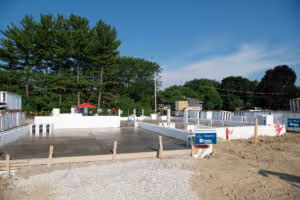
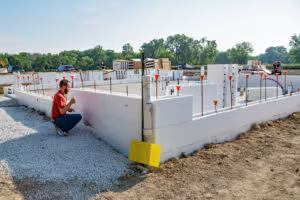
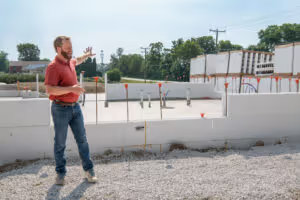
The first phase of a residential development provided an opportunity to see how the system performed in practice and how it compared with alternatives already familiar to the installation teams.
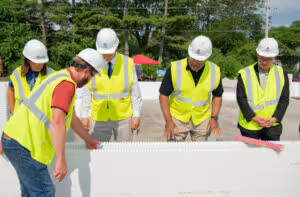
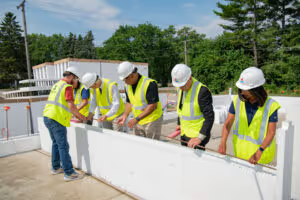
For Paul, that feedback was one of the most valuable parts of the project. The installers had experience working with other ICF systems and were comparing BuildBlock against products they had already used on previous developments.
They highlighted how easily the blocks stacked, how accurately they aligned, and how few adjustments were required during installation. For the teams on site, that meant less time correcting work, fewer interruptions during the build, and a more straightforward installation process from one unit to the next.
Those differences become increasingly valuable as developments grow in size. When the same installation process is repeated across dozens of homes, small improvements are carried through every phase of construction. Time spent adjusting, correcting, and reworking can instead be spent moving the project forward.
“What stood out was how quickly the installers recognised the difference for themselves. It validated how good the system is compared to market alternatives.” Paul Conway
That experience reinforced something Paul has believed for a long time. Construction methods should not be judged solely on how they perform during installation.
The industry often evaluates construction methods through upfront cost and programme. Those factors will always matter, but Paul believes they can dominate conversations that should be taking a much longer view.
The decisions made during construction influence how a building performs for decades afterwards. Thermal performance, energy efficiency, durability, and occupant comfort are all affected by the quality of the building envelope and the consistency with which it is delivered.
For Paul, the discussion becomes more interesting when construction methods are evaluated over the full life of the asset rather than the initial build programme. A system may require greater investment at the outset, but that investment also influences future energy demand, operational performance, and the experience of the people using the building every day.
The question is not simply how quickly or cheaply a building can be delivered. It is how well that building will perform over the next thirty or forty years.
If the decisions made before construction influence both how a building is delivered and how it performs for decades afterwards, those decisions deserve more attention than they often receive.
Learn more at BuildBlock.ie