Walk onto a residential development project in Ireland:
Work moves in stages.
Progress depends on sequencing.
Conditions dictate output.
Paul Conway has worked as a PM in these environments for years. His view is straightforward.
“We’re still leaning on old methods of construction… they’re slower build methods.” Paul Conway
As building performance standards are now mandated by law, using these traditional methods have resulted in extended programmes, cost creep and reduced certainty.
Paul’s view on ICF (insulated Concrete Formwork) started at his family home in Bunclody. In 2006, he built a two-storey extension onto the house using ICF. It connects directly to the original cavity wall house. He describes it simply as passing the Mammy test - the extension holds its temperature and feels consistently warmer than the original structure beside it.
The contrast in performance has remained the same over time. Same house. Same conditions. Different performance.
“The difference in comfort level… The new part of the house was 5 to 10 degrees warmer… it held its temperature.” Paul Conway
That experience gave him a benchmark for how a building should perform and he’s been pondering it ever since.
Traditional housing delivery is built around sequence. You complete one stage before the next can begin. Foundations, rising walls, cavity construction, insulation. Each step depends on the previous one finishing cleanly.
Blockwork sets the pace. Crews can only progress to a limited height each day. Labour, plant, and materials all need to be in place at the same time to maintain output.
When conditions change, progress stops. The end-date holds while the programme lags and cost creeps.
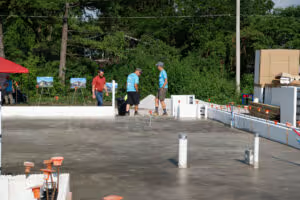
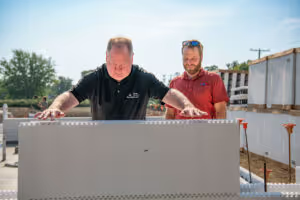
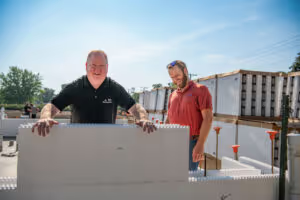
ICF changes how the build moves on site. Wall construction no longer depends on blocklayers. The structure and insulation are installed together as part of the same process which removes multiple steps from the programme.
There is no cavity wall to build in stages. There is no separate insulation install. Material handling is reduced, and fewer teleporters are needed - fewer spotters, crews are smaller, lower labour costs and reduced health and safety risk.
Work continues even if the weather is bad - the pace of the build is consistent.
“You can reduce your programme by 50%.” Paul Conway
Work continues in conditions that would normally stop progress, reducing the overall time on site. For developers, that brings forward delivery and return on investment. For contractors, it reduces exposure to delay and cost pressure.
Fewer moving parts + fewer delays + less waste and rework + fewer bodies on site = greater certainty of cost and programme.
The requirements have changed. Performance targets are higher. Airtightness standards are stricter, and at the same time, projects need to move faster.
ICF aligns with both.
“The regulations have caught up… the system has come into its own.” Paul Conway
It delivers the required performance without adding extra stages to the build.
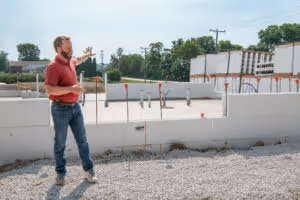
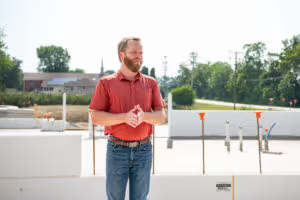
Paul’s decision to bring BuildBlock ICF into the Irish market came from seeing that difference clearly, both on site and in practice.
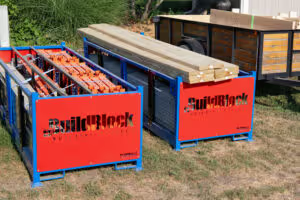
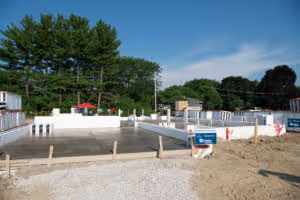
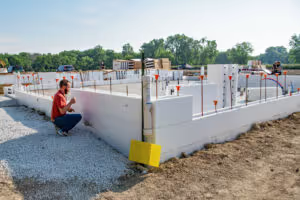
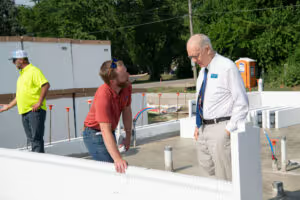
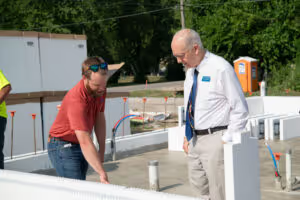
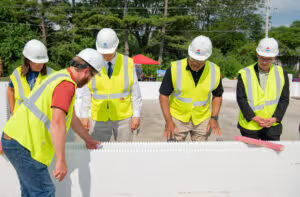
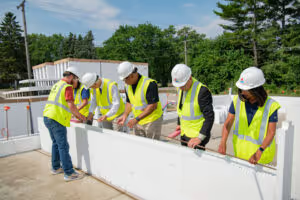
BuildBlock is a rigid EPS formwork system that is stacked dry and filled with concrete to form the structure. The insulation remains in place, so the wall is built and insulated in one operation.
There is no cavity to construct and no separate insulation install. The wall is formed in a single pour rather than built up in stages.
Installation is handled by a small crew and does not rely on blocklayers or mortar systems.
That approach suits how projects need to be delivered in Ireland now.
You can see how the system is being applied across current projects here.