Ireland’s construction sector has long delivered housing using established skills and proven methods. Those foundations remain central to how homes are built and will continue to be.
What has changed is the level of predictability now required to deliver housing at scale.
Programmes are tighter, regulatory requirements are more detailed, and expectations around building performance are higher. As delivery pressure increases, the point at which certainty is created becomes more important.
Modern methods of construction sit naturally within this context. They support housing delivery by resolving more decisions earlier in the process and reducing the amount that must be managed on site. This approach strengthens existing practice rather than replacing it.
Housing delivery becomes harder when key decisions are left to be resolved during construction. Interfaces between structure, insulation, services, and compliance requirements introduce uncertainty that grows as timelines compress.
Modern methods of construction address this by shifting when certainty is created. By resolving more decisions at design and manufacturing stage, MMC reduces the volume of coordination and interpretation required on site. Components arrive with defined tolerances, performance expectations are established earlier, and fewer outcomes are left to be negotiated during the build.
This does not change the role of skilled construction teams. It supports them by reducing variation and allowing effort to be focused on delivery rather than correction.
The value of MMC is often discussed in terms of speed, but its real contribution lies in risk reduction. When systems are manufactured under controlled conditions, uncertainty is removed before construction begins rather than absorbed later on site.
For housing delivery, this matters more than innovation for its own sake. Projects that scale successfully tend to rely on approaches that behave consistently, integrate cleanly with regulation, and allow teams to plan with confidence. MMC provides a framework for doing this when it is applied with discipline and clarity.
Not every system achieves this equally. The effectiveness of MMC depends on how well it embeds performance and compliance into the build process rather than relying on correction during construction.
As regulatory requirements continue to evolve, compliance now influences design decisions from the outset. Structural behaviour, fire performance, thermal efficiency, and documentation all need to be addressed clearly before construction begins.
System-led construction supports this by making performance a property of the system itself. When outcomes are defined through manufacturing standards and supported by documentation, confidence is established earlier for designers, engineers, and regulators.
This approach does not replace good design or competent site execution. It reduces the number of variables that can undermine them.
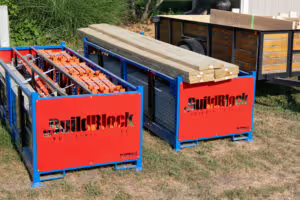
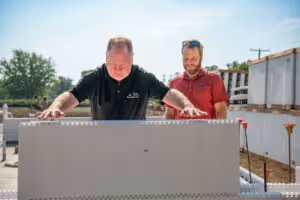
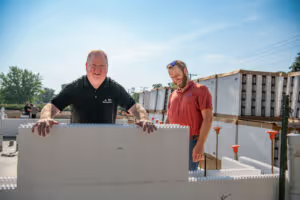
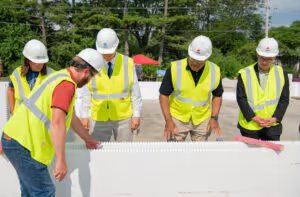
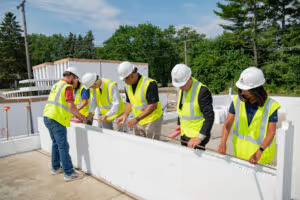
Within this broader approach to delivery, insulated concrete formwork aligns with MMC principles in a way that fits established construction practice.
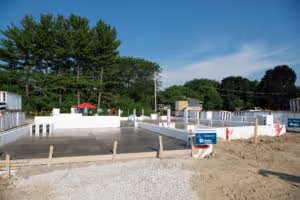
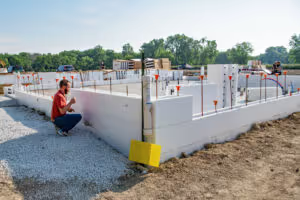
By resolving structure, insulation, and airtightness as part of a single wall system, ICF reduces interfaces that traditionally require coordination on site. Performance characteristics are inherent to the system rather than dependent on later additions or remedial detailing.
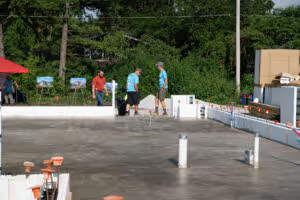
Manufactured under controlled conditions and aligned with recognised standards, ICF supports consistency while remaining compatible with familiar site workflows. This balance is particularly relevant for housing projects where repeatability and programme certainty are important.
Sustainability outcomes are shaped not only by materials and technologies, but by how buildings are constructed. System-led approaches reduce waste through more accurate manufacturing and shorter programmes, while also supporting stronger in-use performance.
When insulation continuity and thermal behaviour are addressed as part of the primary structure, operational efficiency improves without relying on corrective measures after completion. In this way, sustainability becomes a consequence of better delivery rather than an additional layer of complexity.
Ireland’s housing needs call for approaches that support delivery rather than stretch existing systems further. Traditional construction remains essential, but it benefits from methods that reduce variability and establish certainty earlier in the process.
Modern methods of construction offer one way of doing this. Insulated concrete formwork demonstrates how system-led thinking can integrate with established practice to support pace, performance, and compliance at scale.
The opportunity now is to assess construction approaches not by how novel they appear, but by how effectively they reduce delivery risk and support consistent outcomes as housing delivery accelerates.