When Paul Conway set out to bring BuildBlock to Ireland, he had an established North American ICF system to work with, backed by more than 20 years of product development and manufacturing experience. However, bringing that technology into the Irish construction market meant developing a system specifically for the standards and conditions it would encounter here.
Ireland's wet climate, building regulations and thermal performance requirements all had to be considered. Equally important was developing a system that architects, engineers and contractors could confidently specify and install, with the technical certification needed to support its use on residential developments.
The result is the BB160 Insulating Concrete Formwork (ICF) wall system, developed using BuildBlock's patented technology and manufactured in partnership with Kingspan at its Askeaton facility in Co. Limerick.
For Paul, who has spent 30 years working in construction, quality was a priority throughout the development process. That meant looking closely at the design of the blocks themselves, including how they connect, how they are handled during installation and how much material can be reused rather than discarded.
BuildBlock's ICF system has received NSAI Agrément certification, Certificate No. 26/0453. The NSAI carried out an in-depth technical assessment of the system for its intended use under Irish building regulations, covering structure, fire, thermal and acoustic performance, and weatherproofing finishes. That is subject to the certificate's conditions and BuildBlock's technical and installation manual.
Paul is clear about what that means commercially. If you or I buy a new home from a developer, the bank won't lend without latent defects insurance, and HomeBond won't provide that cover unless the system is certified. Having reviewed BuildBlock's NSAI certification, HomeBond treats the system as approved and insurable. Consultants and assigned certifiers need the same certification before they will stand over a system and sign off against it.
"It then opens the door for trusted use across the Irish construction market." Paul Conway
A big part of the NSAI assessment was a factory audit. BB160 is manufactured by Kingspan, whose Askeaton facility already runs fully ISO-certified processes, so the testing and record-keeping the audit focused on were already in place. Quality checks happen at different stages of production every day, and each block is recorded against the batch of raw material it was made from. If an issue is ever raised on site, it can be traced right back through Kingspan's processes to that raw material.
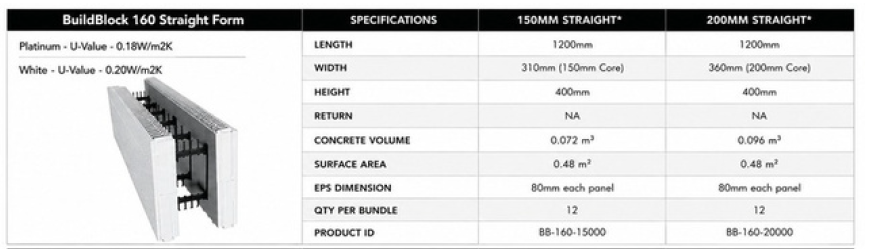
In its platinum EPS configuration, BB160 achieves a U-value of 0.18 W/m²K, meeting the current Part L backstop for external walls, within a wall just 310 mm wide. Alternative ICF configurations need around 350 mm to reach comparable performance.
On a one-off or semi-detached house, 40 mm per wall makes little difference. On apartments and terraced units, Paul says it adds up quickly:
"If you're constricted by a dimension while you're building and each unit is creeping by 80 millimetres across ten units, now you're crept by nearly a metre. You mightn't fit the same number of apartments or your design may have to change." Paul Conway
Homes are sold by floor area, so wall thickness is space a developer can't sell. The slimmer wall also keeps BB160 cost competitive against wider 350 mm blocks. Achieving 0.18 in a 310 mm wall is the main reason BuildBlock chose to manufacture BB160, and why it suits larger residential developments.
Suggested graphic: BB160 Technical Data Sheet, page 2: the BuildBlock 160 Straight Form specification table, showing the 310 mm width (150 mm core) and the 0.18 W/m²K platinum U-value.
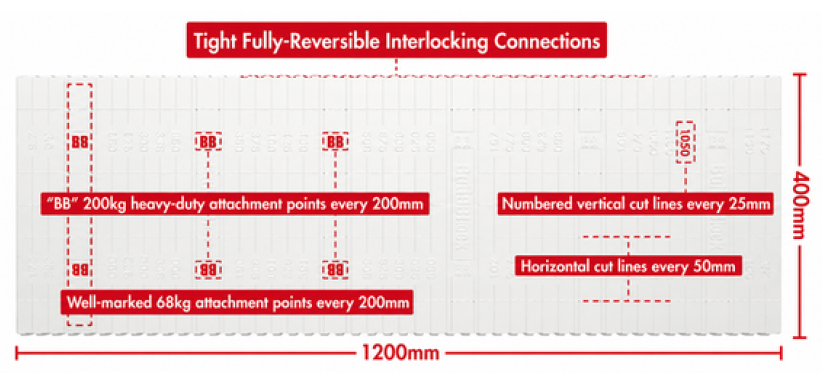
Other ICF systems on the market connect at 50 mm or 100 mm increments. BuildBlock's is the only one that connects every 25 mm. That finer increment is what lets installers reuse their offcuts. Any piece with two webs goes back into the wall, and in certain cases single-web pieces can be reused in the upper courses, where concrete pressure is lower. With offcuts reused, the system is designed to get waste down to around 1%.
The connection is a 100% surface-to-surface interlock. Blocks click together easily but form a tight friction bond, so in most cases no foam is needed between courses.
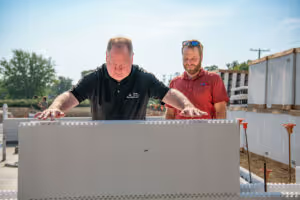
The blocks are fully reversible, with no top, bottom, inside or outside, and a 400 mm block can be cut into two 200 mm halves and flipped for reuse. Other ICF blocks are reversible too. What sets BuildBlock apart is the cut pattern moulded into every block: vertical cut lines at 25 mm intervals, horizontal lines at 50 mm intervals, and a tape measure marked from 0 to 1,200 mm. Installers can see exactly where to cut.
Suggested graphic: BB160 Technical Data Sheet, page 1 (bottom): the "Tight Fully-Reversible Interlocking Connections" diagram. For a close-up of the moulded tape measure: BuildBlock Technical & Installation Manual, page 25, Figure 1.3.11. Link to the datasheet here once it is live.
BB160's hard fixing points are designed to help walls handle Irish weather, such as high winds in the west, before the concrete is poured.
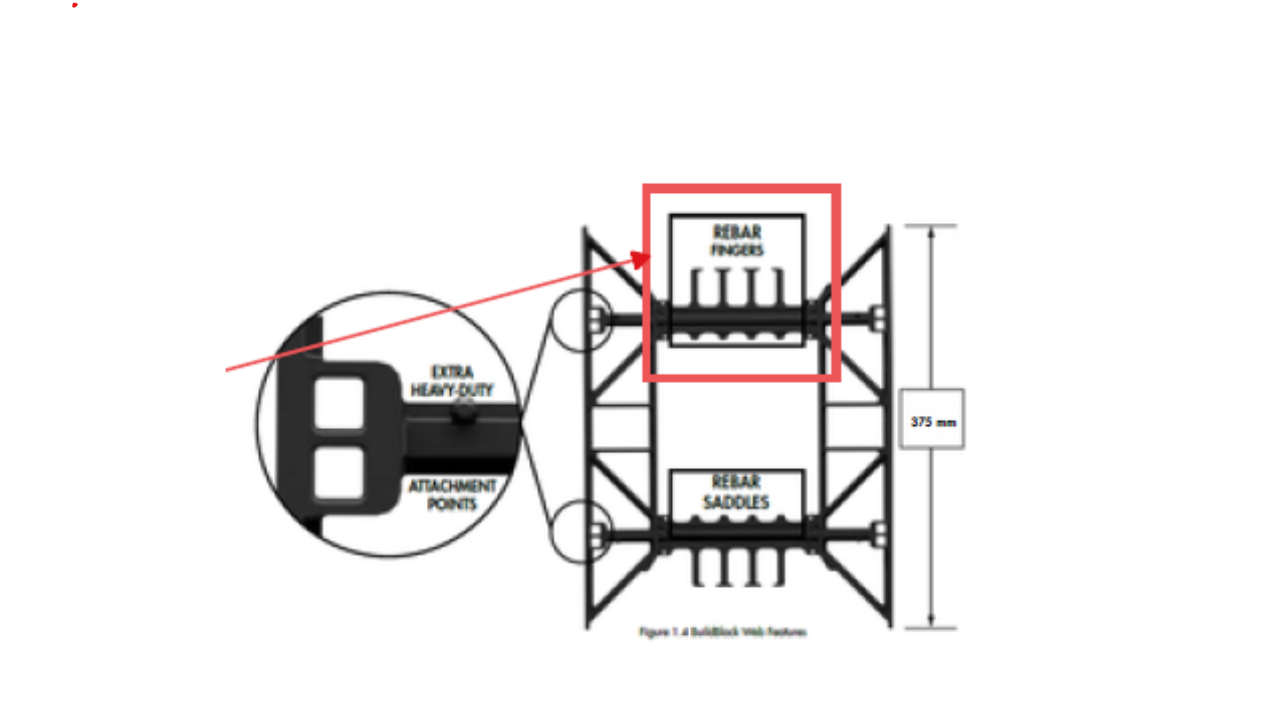
Every web acts as a stud at 200 mm centres, giving about 70 kg of pullout capacity anywhere along its face, depending on the type of screw used. At the hard fixing points, marked BB on the block every 200 mm vertically and horizontally, that rises to over 200 kg, nearly three times the capacity. No other ICF system has them. Strongbacks and props can be connected through these points before the pour, and once the wall is poured the same points take cabinetry inside and finishes outside.
The webs also replace internal studwork. Plasterboard fixes directly to them, so no secondary studs are needed to line the walls. U-shaped receivers on top of each web hold the horizontal reinforcement, which keeps rebar tying to a minimum.
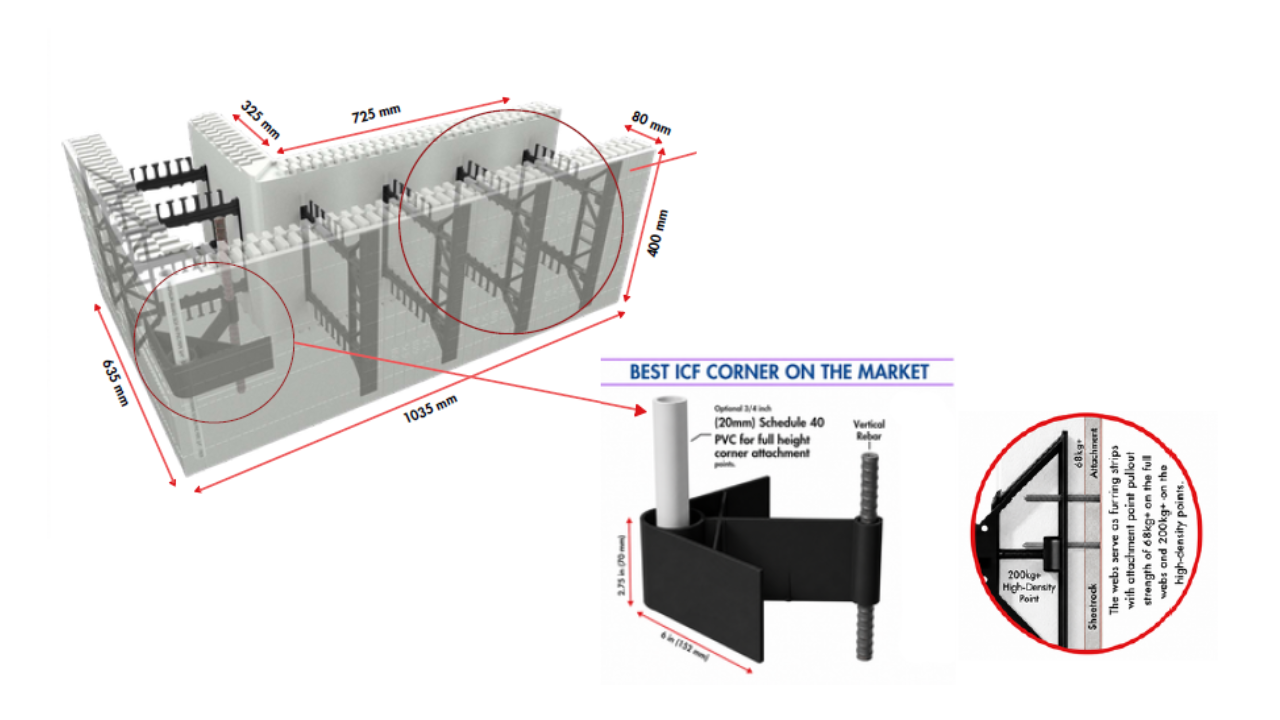
BuildBlock's corner block is the largest on the Irish market. Each leg is 200 mm longer than competing systems, with an extra web in each direction.
On other ICF systems, the last web on each side stops short of the corner, leaving a gap with nothing to fix props or finishes to. BuildBlock is the only system with a built-in corner web, 70 mm high by 150 mm long in each direction, in every corner block. On a finished wall, that gives a fixing point every 400 mm all the way up the corner.
BB160 is manufactured by Kingspan at Askeaton, combining more than 20 years of BuildBlock ICF design with more than 40 years of Kingspan shape-moulding expertise. Paul's focus in the factory is the best possible block every time, using the best quality bead and setting cycle times around quality.
That same focus carries through to delivery. EPS can be damaged in handling, particularly if forklift tines go through a pack, so BuildBlock has gone with a higher standard of packaging to protect the blocks from the factory to the wall.
BuildBlock packs blocks in bundles of 12, each sitting on a cardboard tray with upturned edges. Bundles are fully UV wrapped, sealed, double-bundled and palletised, so they come off the lorry two pallets at a time without forklift tines going through the EPS. The trays also protect the bottom block when bundles are dragged across a floor on site.
Paul says the feedback on this approach from developers and contractors has been very positive, and it does reduce damage on site, although blocks still need to be stored and handled correctly by the main contractor. On one development, low waste and the palletised block were two of the big items for the contractor.
Paul says competitors deliver waste levels of around 3–5%, compared with the 1% BuildBlock's system is designed for, so BuildBlock can reduce waste by 2–3%. On a standard semi-detached house, he estimates that is worth €200–€300 in material.
Across a 100-home development, that is €20,000–€30,000. Some developers are aiming to deliver 500 or even 1,000 homes a year, and the saving grows with them.
The material is only part of it. Waste still has to be moved and taken off site, and Paul says much of that cost sits where developers don't look for it:
"It's managing that waste, it's the labour having to remove it, it's teleporters and skip servicing it, the man-hours gone into managing that waste as well." Paul Conway
Those costs sit in the preliminaries, where Paul says people don't see the savings. ICF in general cuts them sharply: Paul estimates it reduces the weight of waste leaving a site around twentyfold compared with traditional construction. One developer told him he was removing roughly 2.5 tonnes of block, sand and offcuts per apartment on a traditional scheme.
For Paul, quality runs from the design of the block to the moment it is stacked in the wall. NSAI certification gives specifiers independent evidence of performance, and Kingspan's manufacturing gives that performance consistency. The details in the block and the way it is packed make sure that quality still holds when it reaches site.
For developers and contractors, those details show up as less material in the skip and fewer hours spent managing it.
Request the BB160 technical datasheet at BuildBlock.ie