
Engineered wall systems designed for predictable performance
BuildBlock delivers an integrated insulating concrete form system for projects where wall construction needs to perform predictably and comply with regulation over the life of the building. By combining structure and insulation within a single manufactured form, the system reduces on-site variation and supports consistent build quality from first course through to concrete placement.
BuildBlock systems are used across residential, commercial, industrial, and institutional construction by designers, engineers, and contractors who need clarity at specification stage and confidence during installation.
Factory-assembled insulating concrete forms
BuildBlock ICF is a factory-assembled wall system that forms reinforced concrete walls with continuous insulation once poured. Blocks arrive on site ready to install and stack without orientation constraints, allowing walls to be set out efficiently while maintaining consistent geometry throughout the build.
Each block is formed from high-density EPS insulation with integrated internal webs. These webs control reinforcement placement within the wall and provide defined fixing points for finishes and services. This internal structure reduces the need for secondary supports and limits ad-hoc cutting on site.
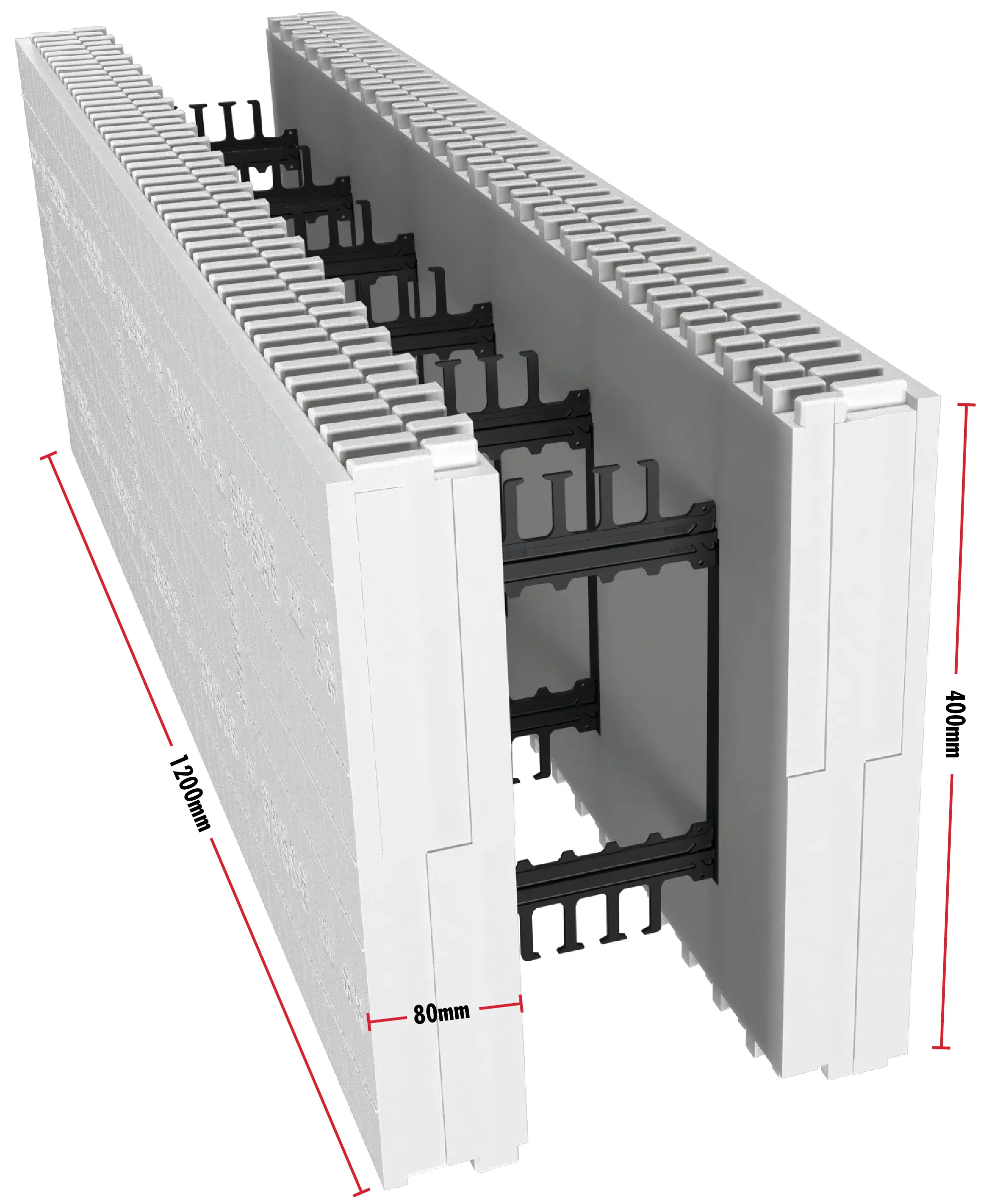
Standard block dimensions of 1200mm by 400mm support accurate setting out and reduce waste during installation. Because the forms are fully reversible, sequencing is simplified and layout errors are reduced, particularly on larger or more complex footprints.
Once poured, the system behaves as a solid reinforced concrete wall with high thermal mass and strong fire and acoustic performance. BuildBlock ICF can be used for loadbearing and non-loadbearing applications and integrates directly with common floor systems, roof structures, and external finishes.
Knockdown configuration within the BuildBlock system
BuildLock ICF is the knockdown configuration of the BuildBlock system. It is supplied as EPS panels and web bridges that are assembled on site to form a complete block. Once assembled, the block matches standard BuildBlock ICF in size, performance, and compatibility.
The knockdown format allows wall thickness to be adjusted where required and supports wider concrete cores without introducing alternative systems or special detailing. This makes it suitable for areas of increased loading, structural walls, or localised features such as pilasters.
During assembly, web bridges lock into place and stabilise the form before the pour. This locking mechanism limits movement during concrete placement and supports clean pours even on thicker walls. After assembly, BuildLock integrates fully with standard BuildBlock forms, allowing both configurations to be used together within the same structure.
The finished wall performs in the same way as standard BuildBlock ICF and follows the same reinforcement logic, installation method, and detailing approach.
Insulated door and window openings
BuildBuck is an insulated bucking system used to form door and window openings within BuildBlock ICF walls. It is manufactured from high-performance EPS with embedded structural webs that anchor directly into the concrete during the pour.
The buck creates square, stable openings that remain dimensionally consistent during installation. Because it is fully insulated, it maintains continuity through the wall and avoids the cold bridging associated with timber or mixed-material bucks.
Integrated anchors provide reliable fixing points for windows, doors, and internal finishes once the wall has cured. This reduces the need for secondary framing and simplifies detailing around openings.
BuildBuck installs as part of the standard ICF workflow and is compatible with BuildBlock 150mm and 200mm wall systems. Its use supports airtight construction and helps avoid condensation issues around openings.
BuildBlock ICF, BuildLock ICF, and BuildBuck are designed to work together as a single system. Dimensions, reinforcement placement, and fixing logic are consistent across all components, allowing the system to be specified and built without introducing unnecessary complexity.
This approach supports predictable construction outcomes and reduces reliance on site-specific workarounds. It allows teams to focus on execution rather than problem-solving during the build.


